
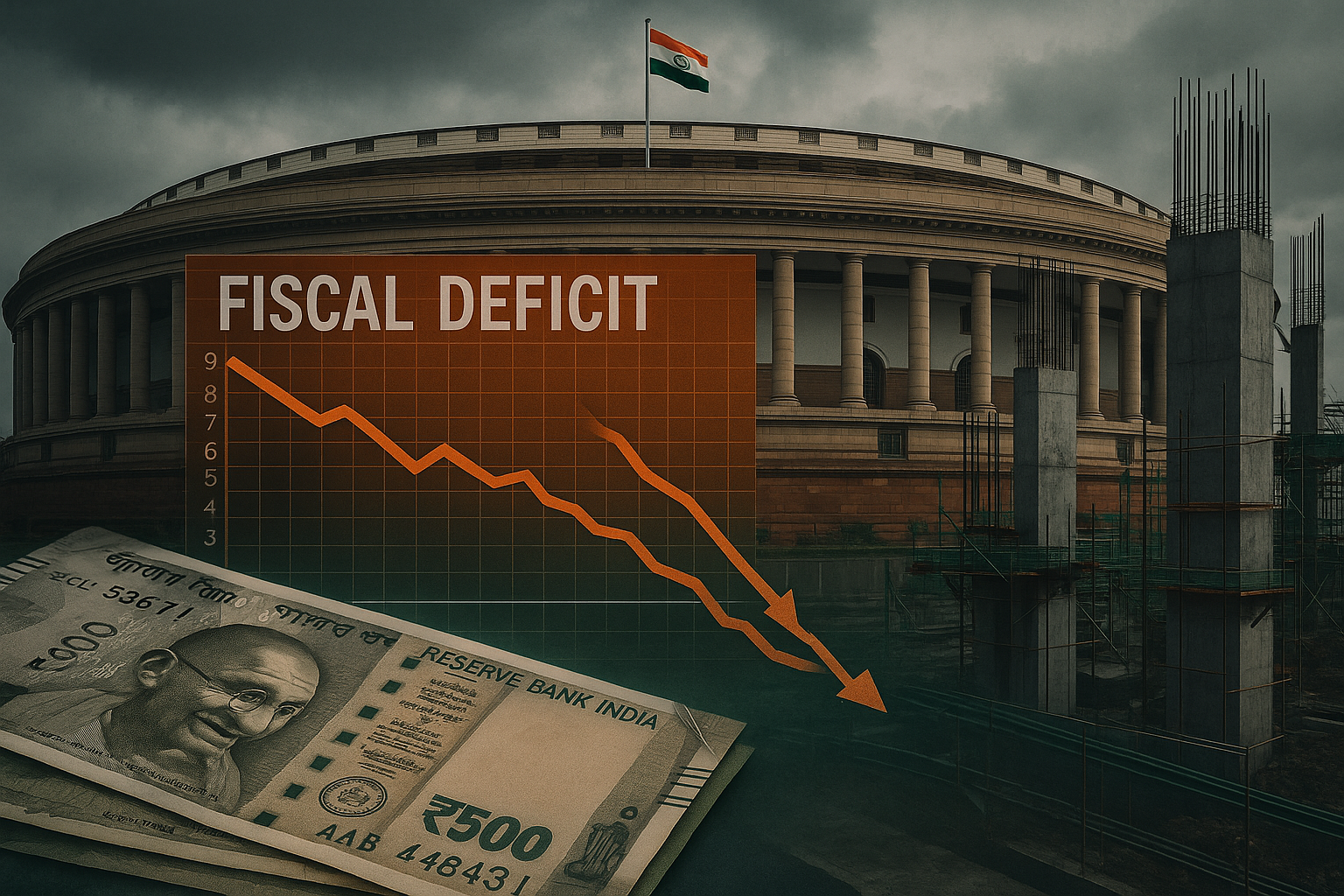
India’s fiscal deficit widened to ₹5.98 lakh crore ($67.3 billion) in the first five months of FY26, accounting for 38.1% of the full-year target. The gap reflects faster government spending compared to revenue growth. While net tax receipts fell year-on-year, higher non-tax revenue and infrastructure-driven capital expenditure partly cushioned the imbalance.
Core Development
Net tax receipts: ₹8.1 lakh crore (vs ₹8.7 lakh crore a year ago).
Non-tax revenue: ₹4.4 lakh crore (up from ₹3.3 lakh crore).
Total expenditure: ₹18.8 lakh crore (vs ₹16.5 lakh crore last year).
Capital expenditure: ₹4.3 lakh crore, sharply higher than ₹3 lakh crore in April–August 2024.
Officials noted that infrastructure push remained the biggest driver of expenditure.
Key Drivers / Issues
Revenue slowdown amid GST cuts and weaker direct tax inflows.
Stronger public investment in infrastructure projects.
Government balancing fiscal discipline with growth support.
Tariff-related global uncertainty clouding external receipts.
Stakeholder Impact
For government finances, higher early spending risks pressure on the fiscal deficit target. Investors and markets watch for bond issuance and borrowing implications. Businesses benefit from capital expenditure-led demand, while consumers see gains from GST relief but potential risks from higher borrowing.
Industry & Policy Reactions
Economists say the deficit is manageable if revenues rebound post-GST reform implementation and festive consumption. However, a prolonged shortfall may require either spending curbs or higher borrowing.
Challenges Ahead
Managing fiscal credibility amid widening deficit.
Ensuring tax buoyancy rebounds after GST cuts.
Preventing crowding out in bond markets if borrowing rises.
Strategic Outlook
The government appears committed to its fiscal deficit target of 4.4% of GDP for FY26, but execution will depend on revenue recovery. Stronger consumption, disinvestment progress, and efficient spending will be critical to maintaining balance.
Why This Matters
The fiscal deficit trajectory influences India’s credit ratings, borrowing costs, and investor confidence. Early overshooting highlights the delicate balancing act between growth stimulus and fiscal prudence.