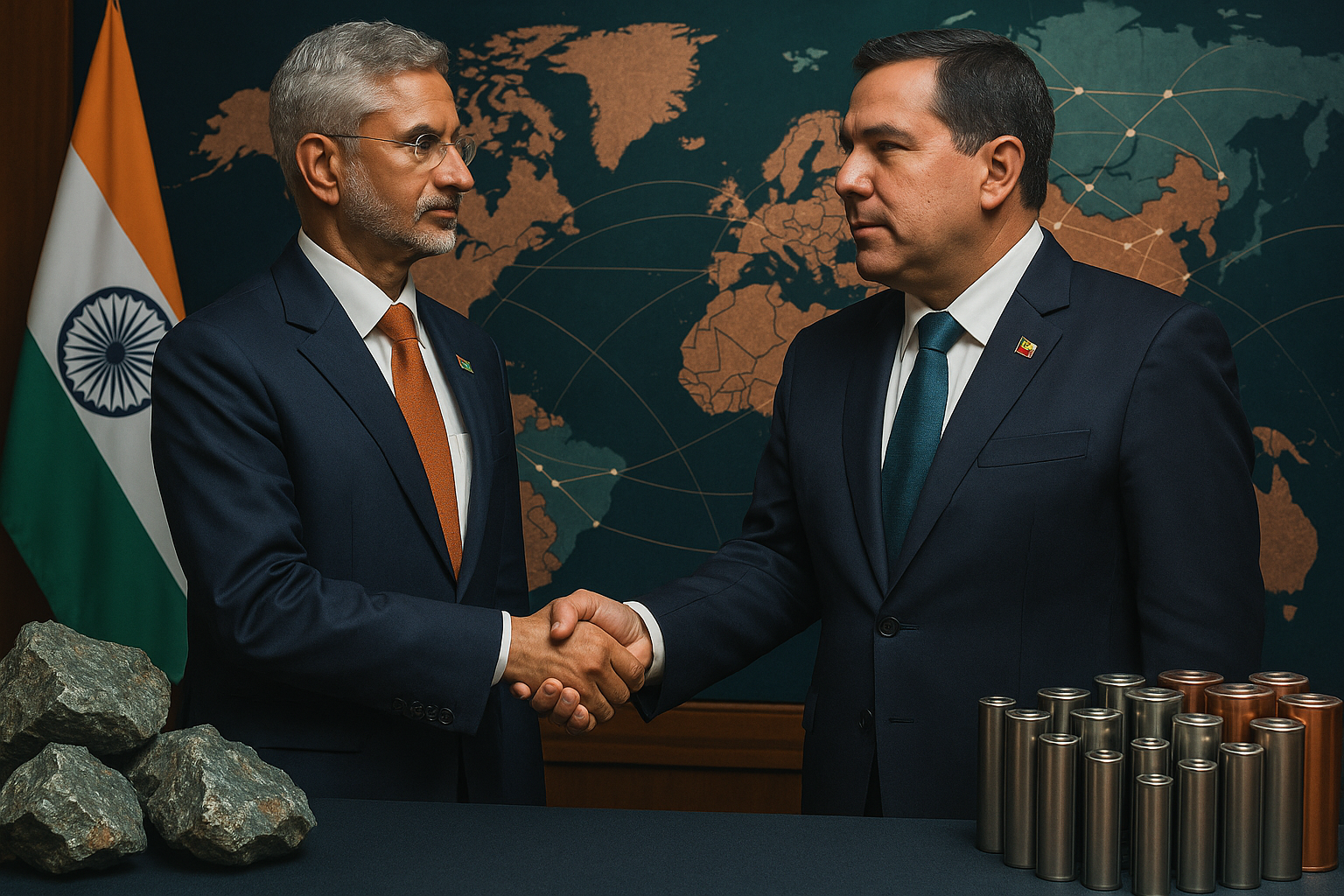
Venezuela has expressed strong interest in expanding cooperation with India in the critical minerals sector, signalling a new phase of strategic engagement at a time when global supply chains are undergoing major realignments. During high-level discussions in New Delhi, Venezuelan officials said the country is eager to partner with India on lithium, graphite, nickel, and rare-earth exploration, alongside building long-term resource security frameworks. The move aligns with India’s growing push to diversify mineral sources essential for batteries, EVs, semiconductors, and renewable energy industries.
Core Development
Venezuelan Vice Foreign Minister for Asia, the Middle East & Oceania, Tatiana Pugh Moreno, met senior Indian officials to discuss bilateral collaboration in mining, critical minerals, and energy partnerships.
Key developments include:
Venezuela offering cooperation in exploration, extraction, and joint ventures.
Interest in partnering with Indian public-sector and private companies in lithium-ion battery value chains.
Emphasis on strengthening bilateral trade, which has seen renewed momentum after years of political and economic turbulence.
Discussion of broader cooperation in pharmaceuticals, technology, and petrochemicals as part of a diversified engagement strategy.
Officials highlighted that Venezuela, home to some of the world’s largest reserves of oil, gold, iron ore, and strategic minerals, aims to utilise Indian investment and technology for resource development.
Key Drivers / Issues
India’s urgent need to secure critical mineral supplies for energy transition and technology manufacturing.
Global race for lithium and rare earths intensifying due to EV expansion.
Venezuela seeking new economic partnerships beyond traditional Western markets.
India’s broader initiative to build resilient, non-China dependent mineral supply chains.
Stakeholder Impact
For Indian manufacturing sectors, especially EV, electronics, and renewable energy companies, the partnership could ensure stable and diversified mineral sourcing.
For Venezuela, Indian participation may bring investment, mining technology, and market access, supporting its economic recovery.
For policymakers, this strengthens India’s global positioning in the clean-tech supply chain.
Industry & Policy Reactions
Analysts view the development as a promising sign of India expanding its mineral diplomacy beyond traditional partners in Australia, Africa, and Latin America. Industry leaders say the collaboration could reduce India’s heavy reliance on a few mineral-rich countries and support a more predictable supply chain for high-growth sectors.
Challenges Ahead
Political and regulatory instability in Venezuela.
High logistical costs and complex mining infrastructure requirements.
Need for long-term investment guarantees and stable trade frameworks.
Navigating international sanctions and geopolitical sensitivities.
Strategic Outlook
India–Venezuela critical mineral cooperation could become a cornerstone of India’s mineral security strategy, especially as global competition for battery minerals accelerates. If structured effectively, the partnership could integrate India deeper into Latin American resource networks, supporting sustainable industrial expansion through 2030 and beyond.
Why This Matters
Securing diversified access to critical minerals is essential for India’s energy transition, semiconductor ambitions, and manufacturing competitiveness—making this partnership a crucial step in strengthening long-term strategic resilience.